Since the birth of Bitcoin, countless digital assets have been created one after another on the blockchain. By using these digital assets, cross-border remittances have become significantly easier than before.
Rise in Scam Alongside Digital Asset Adoption
While these developments have brought convenience, cross-border crimes involving digital assets (especially scam) are frequently occurring. Examples include Ponzi schemes, HYIPs (High Yield Investment Programs), illegal multi-level marketing schemes (also called network business or network marketing)*1, and pyramid schemes. During the cryptocurrency boom a few years ago, ICO scams and mining scams were also commonly seen.
*1 Multi-level marketing itself is not illegal, but the solicitation methods may involve illegal behavior.
Difficulty in Tracing Crypto-related Scam
Even if one falls victim to scam, cryptocurrency addresses (accounts) are not linked to personal information unless an identity-verified exchange is used. This makes investigations even more difficult than those for conventional bank transfer scams. Incidentally, even if the exchange requires identity verification, if the funds are converted into privacy coins midway through*2, they may still be cashed out.
*2 A common misconception is that Bitcoin is encrypted or anonymous—it is not.
Here, “anonymous” means that the sender and recipient addresses are hidden.
Bitcoin addresses are not directly linked to personal information, so the anonymity is only pseudo-anonymous.
Mathematical Structure of Pyramid Schemes
Now, as the title suggests, let’s mathematically examine one type of scam: the pyramid scheme (also known as a pyramid structure).
Membership Structure and Reward Mechanism
In pyramid schemes, members earn rewards by recruiting others into the same scheme. Each member (parent) is required to recruit several new members.
New members (children) pay entry fees or other charges, a portion of which becomes a referral fee paid to the recruiter (parent). Furthermore, if the children recruit their own new members (grandchildren), both the parent and child receive referral fees. This increasing chain of recruitment is likened to the reproduction of rats, hence the term “rat scheme🐭” (nezumi-kō in Japanese). Mathematically, this is a geometric series similar to calculating how many rats multiply over time.
Geometric series and Tiered Structure
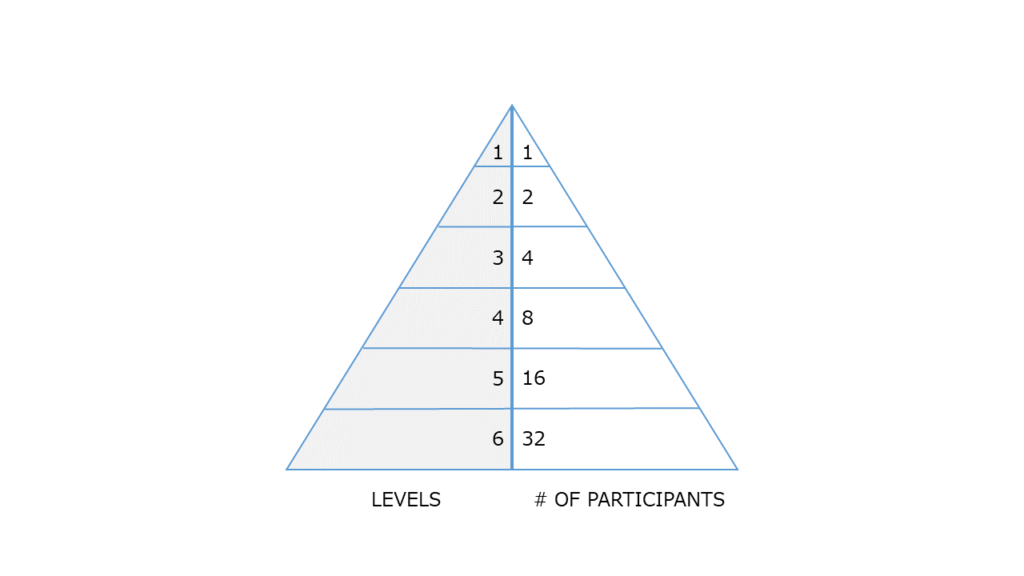
Let’s assume that each member must recruit two new members in order to earn rewards. If we consider the scheme’s originator as Tier \(1\), Tier \(2\) will have \(2\) people, Tier \(3\) will have \(4\), and so on.
This structure forms a geometric series with the first term \(1\) (originator) and a common ratio of \(2\) (new recruits), so the total number of people up to Tier N is:
\[ \frac{1 \times ( 1-2^N )}{ 1-2 } = 2^N-1. \]
By Tier \(26\), the total number of members becomes \(67\) million, and by Tier \(27\), the number exceeds Japan’s population. This leads to saturation of the membership and bankruptcy.
Visually, the structure resembles a pyramid, which is why it is called a “pyramid scheme.”
Exceeding the U.S. Population
Conversely, under the same conditions, let’s determine when the total number of members would exceed the U.S. population of 329,065,000 (as of 2019). We find the smallest tier number (natural number) N that satisfies the following inequality:
\[ 2^N-1 > 329065000 \] \[ \Leftrightarrow 2^N > 329065001. \]
Taking log base \( 2 \) of both sides:
\[ N > \log_2 (329065001) \]
\[ \Leftrightarrow N > 28.293797350225926. \]
Thus, the smallest integer \( N \) that satisfies this condition is \( 29 \).