Why Did High School Students Choose a “Complicated Method”?
This fascinating example of “fixed thinking” and “solution rigidity” in mathematics education comes from a story shared by a university professor who participated in entrance exam grading.
The professor was tasked with evaluating mathematics exams for humanities-track students. He was very surprised when he saw the answer to one of the questions.
Problem:
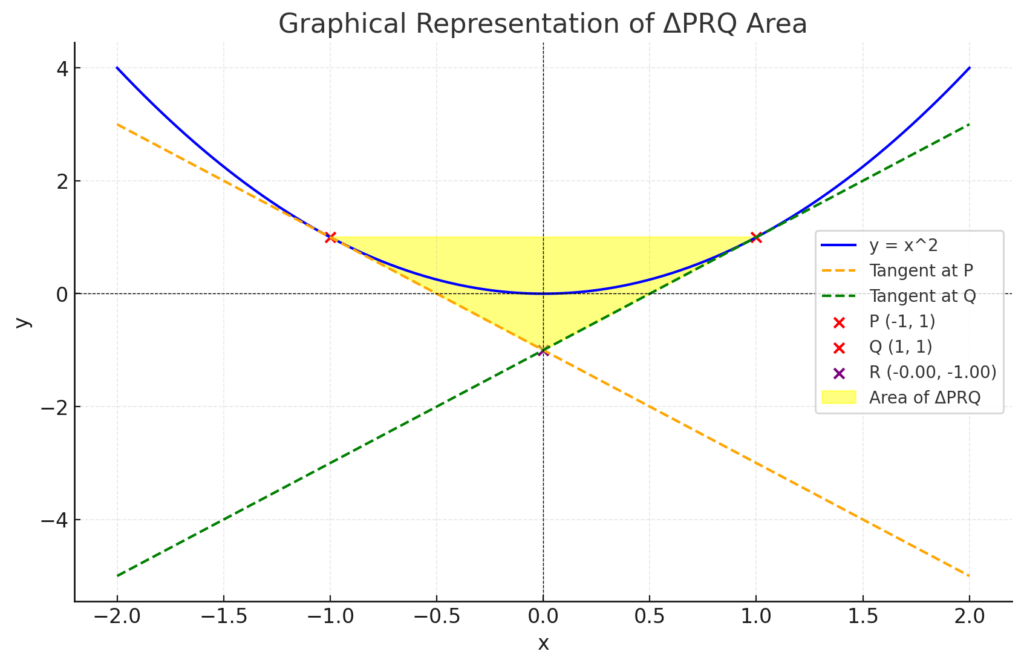
Suppose that the tangent at point \( P(a,a^2) \) and the tangent at point \( Q(b,b^2) \) of the curve \( y = x^2 \) intersect at point \( R \). Assume \( a<0<b \). Answer the following:
Find the coordinates of point \( R \) and the area of \( \triangle PRQ. \)
Different Approaches to the Solution
This problem can be solved using either a simple method or a complex method.
Simple Method:
- Calculate the coordinates of point \( R \).
- Let \( R^\prime \) be the intersection of \( PQ \) with a line parallel to the \( y \)-axis passing through point \( R \).
- Use the formula area of \( \triangle PRQ=\frac{1}{2}\times |RR^\prime | \times (b-a) \).
Complex Method (used by most students):
- Calculate the equation of \( PQ \) and subtract the tangent line at \( P \). Use integration to compute the area between \( P \) and \( R^\prime \).
- Similarly, Calculate the equation of \( PQ \) and subtract the tangent line at \( Q \). Compute the area between \( R^\prime \) and \( Q \).
- Sum the results of the two integrations.
Clearly, the latter involves more steps and tedious calculations. Surprisingly, the majority of students chose this complex approach😂. Why?🤔
Why Did Students Choose the Complicated Approach?
- Overemphasis on Integration: In high school mathematics, calculating areas via integration is heavily practiced. When students see “find the area,” their instinct is to default to integration, even if simpler methods exist.
- Lack of Geometric Intuition: A geometric approach requires understanding relationships between points and lines on a coordinate plane. Many students are more comfortable with algebraic computations than with geometric reasoning.
- The Problem Statement’s Influence: The problem mentions tangents and intersections, which are geometric concepts, but the term “area” triggers the association with integration. This subtly directs students toward using integration.
- “Complex Equals Correct” Misconception: Students often mistakenly believe that using more complicated methods is more likely to be correct or rewarded in exams. In reality, concise and efficient solutions are preferable, but under test pressure, students tend to play it safe with exhaustive methods.
- Teaching Influence: If teachers or tutors have emphasized integration-based methods in the past, students are likely to stick to what they’ve been taught rather than exploring alternative approaches.
- Fixed Thought Patterns: Once students associate area calculation with integration, it becomes difficult for them to consider other methods. This phenomenon is especially pronounced under the stress of an exam.
Lessons to Be Learned
This story highlights some challenges in mathematics education:
- Fostering Geometric Intuition: Developing an intuitive grasp of geometry can help students identify efficient solutions.
- Encouraging Diverse Problem-Solving Approaches: Students should be trained to consider multiple ways to solve a problem rather than defaulting to a single familiar method.
- Teaching the Importance of Simplicity: Efficient, straightforward solutions should be celebrated to combat the misconception that complexity is inherently better.
Closing Thoughts
The tendency of students to choose the more complex method reflects the influence of the education system and learning habits. However, experiences like these can serve as valuable lessons, emphasizing the importance of pursuing efficient and insightful solutions. Mathematics is not just about calculation; it is a discipline that nurtures creative thinking and problem-solving skills.