Definition
Let \( K \) be a subset of the \( n \)-dimensional Euclidean space \( \mathbb{R}^n \).
When any line segment \( \overline{xy} \) that connects two any points \( x \) and \( y \) in \( K \) is also contained within \( K \), we say that \( K \) is a convex set in \( \mathbb{R}^n\):
\[ x,y \in K \Rightarrow \overline{xy} = \{(1−t)x + ty\ ;\ 0 \leq t \leq 1, t \in \mathbb{R}\} \subset K.\]
Examples of Convex and Non-Convex Sets
- An \( (n−1) \)-dimensional disk \( D^{n-1} \) is a convex set in \( \mathbb{R}^n \).
- A cube is a convex set in \( \mathbb{R}^3 \).
- \( \mathbb{R}^n \) itself is a convex set.
- The empty set is also regarded as a convex set.
However, an \( (n−1) \)-dimensional sphere \( S^{n-1} \) is not a convex set in \( \mathbb{R}^n \).
Visualizing Convexity and Observing the “凸” Character
Illustration of Convex Sets in \( \mathbb{R}^2\):
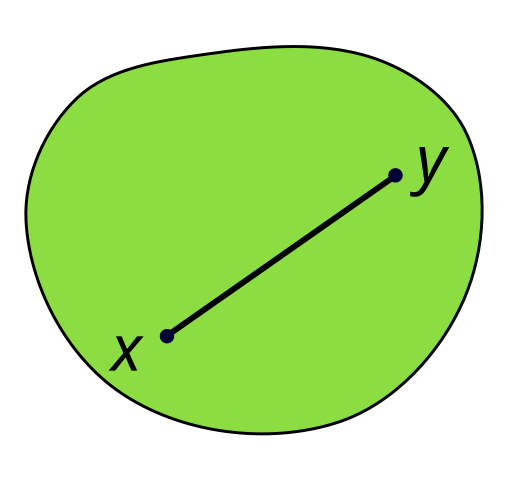
Illustration of a convex set shaped like a deformed circle. The line segment joining points x and y lies completely within the set, illustrated in green. Since this is true for any potential locations of two points within the set, the set is convex.
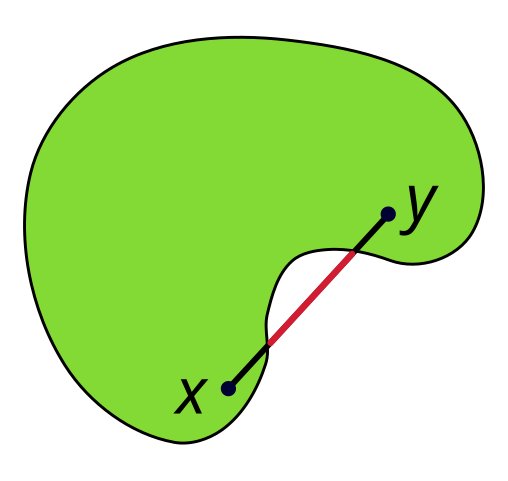
Illustration of a non-convex set. The line segment joining points x and y partially extends outside of the set, illustrated in red, and the intersection of the set with the line occurs in two places, illustrated in black.
Some of you may have already noticed this, but if you focus on the character “凸” (meaning “convex” in Japanese) and imagine it as a subset of \( \mathbb{R}^2 \), it’s clearly not a convex set.
So, when convex sets are explained as above, is it only me who feels that the character “凸” doesn’t quite give that impression? 🤔