When a butterfly🦋 flaps its wings in one place, a tornado🌪️ occurs on the other side of the earth.
This is a metaphor for the phenomenon that started chaos theory at the beginning of the movie “The Butterfly Effect,” in which small differences in initial conditions can make a big difference in future outcomes.
The Lorenz Equation
It was first discovered in a nonlinear differential equation called the Lorenz equation: \[ \frac{dx}{dt} = -x\sigma +\sigma y, \] \[ \frac{dy}{dt} = rx-xz-y, \] \[ \frac{dz}{dt} = xy- \beta z. \] where \( t \) is time, and \(\sigma \), \( r \), and \( \beta \) are positive constants.
The Lorenz Attractor
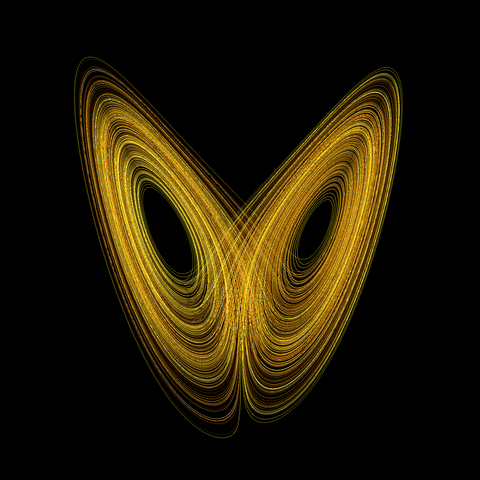
For \( \sigma = 10, r = 28, \) and \( \beta = 8/3 \), the American meteorologist Lorenz discovered an interesting attractor, which has come to be called the Lorenz attractor. It is characterized by the following features:
- Sensitive Dependence on Initial Conditions: Slight differences in initial conditions lead to vastly different outcomes.
- Non-Periodic Behavior: The trajectory never returns to the same point.
- Bounded: Despite lacking order, the trajectory settles within a bounded region.
This is one of the examples of a strange attractor. The trajectory of the Lorenz attractor resembles the wings of a butterfly, as illustrated in the figure.
Chaos in Everyday Life
Let me give you an example of chaos that you may be familiar with. Why do weather forecasts sometimes fail? Perhaps it is because the weather system is chaotic. In fact, long-term forecasts are impossible. On the other hand, if the initial conditions are close, the trajectories will be close for a while, so it is possible to forecast in the short term, and the weekly forecast is usually correct.