Overview
Fulton B. Gonzalez’s lecture series, Lectures on Integral Geometry and Harmonic Analysis, was held from December 2009 to January 2010. Based on this intensive course, the lecture notes were published as COE Lecture Note Series 24 in 2010. Gonzalez, a student of the renowned mathematician Sigurdur Helgason, has made significant contributions to the fields of Integral Geometry and Harmonic Analysis.
This lecture series focused on the mathematically profound and widely applicable theory of the Radon transform. In particular, it explored the modern group-theoretical perspective on the Radon transform.
Contribution to the Lecture Notes
After the lecture series concluded, I contributed to the refinement of the lecture notes by sending Fulton B. Gonzalez a list of corrections. Out of the total 103 pages, I reviewed approximately 75 pages and identified 38 errors, which were subsequently corrected in the published version. My name was acknowledged in the preface of the lecture notes as recognition for this contribution. This experience was a valuable opportunity to engage deeply in academic collaboration and the process of producing high-quality lecture materials.
Lecture Content: The Radon Transform and Its Applications
The primary focus of the lectures was the Radon transform, covering its fundamental definitions and advanced applications.
What Is the Radon Transform?
The Radon transform maps the space of compactly supported, continuous, complex-valued functions on a set \( X \), denoted as \( C_c(X) \), to the space of functions on another set \( \Xi \) through an integral transformation. While originally a topic of mathematical interest, the Radon transform has found critical applications in modern society, such as in CT scans used in medical imaging.
The Group-Theoretical Perspective
The Radon transform is framed within a group-theoretical structure. Specifically, consider the following setup:
- \( G \): a locally compact topological group
- \( K\), \( H \): closed subgroups of G
- \( K \), \( H \), \( K \cap H \): all unimodular
Given this structure, the double fibration
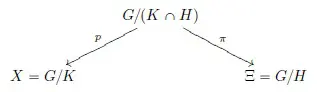
where
\[ p(g(K \cap H))=gK,\ π(\gamma (K \cap H))=\gamma H \]
defines the framework for the Radon transform.
Specific Types of Radon Transforms
In addition to the general theory, the lectures covered two specific types of Radon transforms associated with particular double fibrations:
Classical Radon Transform
- \( M(n) \): the group of isometric transformations on \( \mathbb{R}^n \)
- \( \Xi_n \): the set of all hyperplanes in \( \mathbb{R}^n \)
- \( \mathbb{Z}_2 \): the group generated by reflection with respect to the plane \( x_n = 0 \) (the plane where the \( n \)-th component of \( x\in \mathbb{R}^n \) is zero)

\(d\)-plane Transform on \( \mathbb{R}^n \)
- \( G(d, n) \): the set of \( d \)-planes (affine \( d \)-dimensional subspaces) in \( \mathbb{R}^n \), known as the affine Grassmannian.

Applications of the Radon Transform
The Radon transform is not just of theoretical interest; it has numerous practical applications. One of the most notable is its use in medical CT scans, where it enables the reconstruction of cross-sectional images of the human body from X-ray data.
Conclusion
The lecture notes are a valuable resource for systematically studying the Radon transform and related theories. They provide key insights into the fields of Integral Geometry and Harmonic Analysis. Moreover, the recognition of my contributions to improving the lecture materials highlighted the importance of academic collaboration. This experience underscored not only the depth of mathematical theory but also its wide-ranging applicability in modern science and technology.