The Lotka-Volterra equation is known as a nonlinear differential equation that provides the simplest representation of a predator-prey system between two species without intraspecific competition. This model describes the interaction between prey (the consumed species) and predators (the consuming species), playing a fundamental role in learning the basics of ecological concepts.
Basic Structure of the Lotka-Volterra Equation
The Lotka-Volterra equation is defined as follows: \[ \frac{dx}{dt} = rx-axy, \] \[ \frac{dy}{dt} = bxy-cy. \]
The variables and constants are defined as:
- \( x \): Population size of prey 🐇
- \( y \): Population size of predators 🐅
- \( t \): Time
- \( r \): Natural growth rate of prey
- \( a \): Predation rate (rate at which predators consume prey)
- \( b \): Effect of the presence of prey on the predator’s growth rate
- \( c \): Natural death rate of predators
All constants are assumed to be positive.
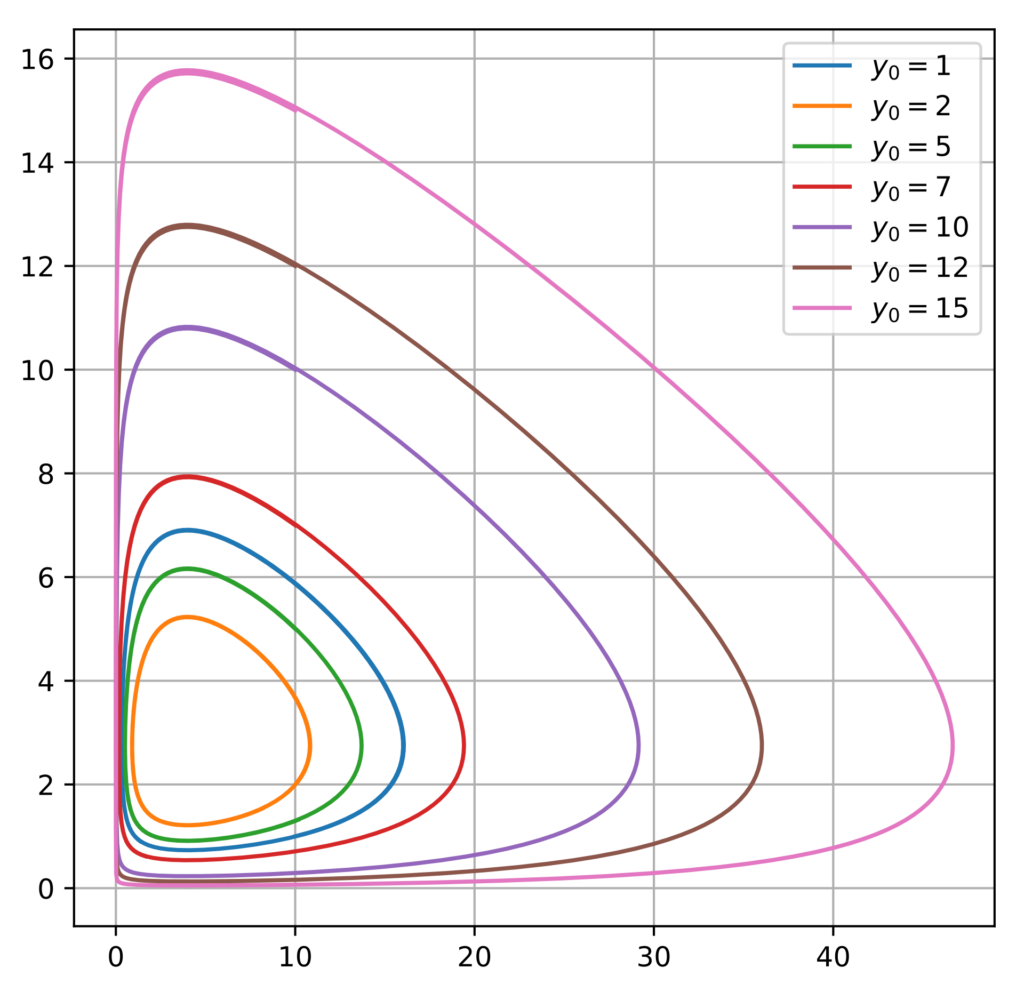
Equilibrium Points and Solution Behavior
This model has the following two equilibrium points on the phase plane:
- Origin \( (0,0) \): A state where neither prey nor predators exist.
- Coexistence equilibrium point \( (c/b,r/a) \): A state where prey and predators coexist.
The solution trajectories are known to move around these equilibrium points on the phase plane, and in particular show periodic behavior around the coexistence equilibrium point \( (c/b,r/a) \).
Limitations of the Model
While the Lotka-Volterra equation is widely recognized as a fundamental model of predator-prey dynamics, it is based on several unrealistic assumptions. For example: In the absence of predators, the prey population grows without bounds.
This assumption fail to sufficiently reflect real ecosystems, necessitating the development of a more realistic model.
Construction of an Improved Model
To overcome the unrealistic aspects of the Lotka-Volterra model, I constructed an improved model where the per capita growth rates depend on both prey and predator populations.
Behavioral Analysis and Simulation
I mathematically analyzed the behavior of this improved model and showed that the solution trajectory has limit cycles (stable periodic solutions) using the Poincaré-Bendixson theorem. A limit cycle means that the system reaches some kind of periodic equilibrium state, representing persistent fluctuations in the ecosystem.
Conclusion and Practical Applications
Although the Lotka-Volterra equation serves an important role as a basis for ecology, it is limited in its ability to accurately reflect real-world ecosystems. The improved model presented in this article overcomes its unrealistic assumptions and provides a more realistic scenario. The model may be used as a theoretical foundation for ecosystem management and biodiversity conservation strategies.
Mathematical models in ecology are powerful tools for understanding real-world ecosystems and are expected to be further developed.