One of my favorite board games is Hex🔶🔷. The rules are incredibly simple.
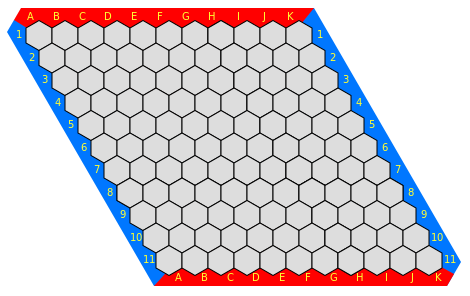
Hex is a two-player game played on a rhombus-shaped board covered with hexagonal tiles. The standard board is an \( 11 \times 11 \) grid with \( 121 \) hexagons, though Hex can be played on boards of any size.
Hex was invented by Piet Hein in 1942 and independently by John Nash in 1948. Nash is well-known from the film “A Beautiful Mind.”
Rules
First, each of the two players chooses a color (red🔶 or blue🔷). Next, players take turns marking hexagonal tiles with their chosen color. The player who connects opposite edges of the board with their color wins. Note that the hexagons in the four corners of the board belong to both sides.
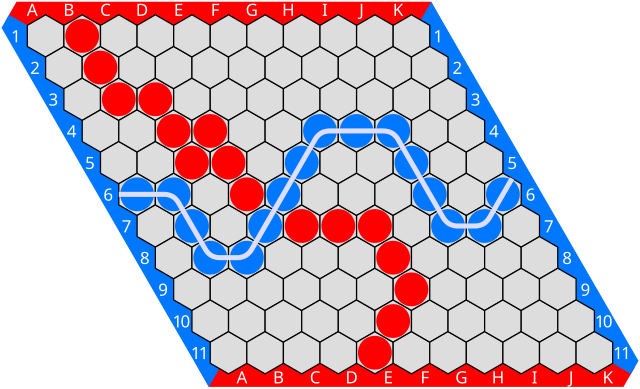
Example of a Blue Win
Properties of Hex
Hex has several mathematical properties, one of which is that there is no draw in Hex. This is intuitively clear from looking at the diagram, as it is impossible to connect opposite sides of either hex. This property was proved by David Gale, who also showed that the fact that there is no draw is equivalent to Brouwer’s fixed point theorem in two dimensions.
D. Gale, “The Game of Hex and Brouwer Fixed-Point Theorem”.
The American Mathematical Monthly 86, 818-827, 1979.
Another important property is that John Nash has proven that Hex is guaranteed to win for the first player (as long as they make no mistakes) on any board of size \( n \times n \). However, since this is an existence proof, the specific winning strategy is unknown.
Although the rules of Hex are simple, finding a general winning strategy is exceedingly challenging, making the game’s strategy quite complex.
The proofs of the two mathematical properties mentioned above are both simple, so if you are interested, please refer to, for example,
J. van Rijswijck, “Computer Hex: Are Bees better than Fruitflies?”
Master’s thesis. Alberta, Canada: University of Alberta, 2000.
By the way, if the first player is guaranteed to win, the second player is at a disadvantage, so the pie rule (also called the swap rule) is applied. That is, after the first player has colored the squares, the second player can choose to “swap red and blue” or “continue as is.”